I Audited 636 Local Business Profiles. Here's What's Actually Broken.
Most “Google Business Profile mistakes” posts are written from imagination. This one is written from a spreadsheet.
Over the past two months I audited 636 US local businesses — law firms, dental practices, CPAs, med spas, HVAC companies and roofers — pulling their public Google Business Profile data and comparing each one against the competitors actually beating them in the map pack. Here’s what’s genuinely broken out there, ranked by how often I saw it.
Methodology. 636 US local businesses — 633 across the six industries I serve (law, dental practices, CPA firms, med spas, HVAC, roofing), plus three home-services companies from a niche I’ve since retired — audited May–July 2026 using each business’s public Google Business Profile data — review counts, ratings, categories, hours — compared against the three competitors actually holding the map pack for that business’s core search. No client data; everything measured is publicly visible. Sample medians: rating 4.9, review count 36 (n = 636 for reviews, 635 for ratings).
1. The rating isn’t the problem. The count is.
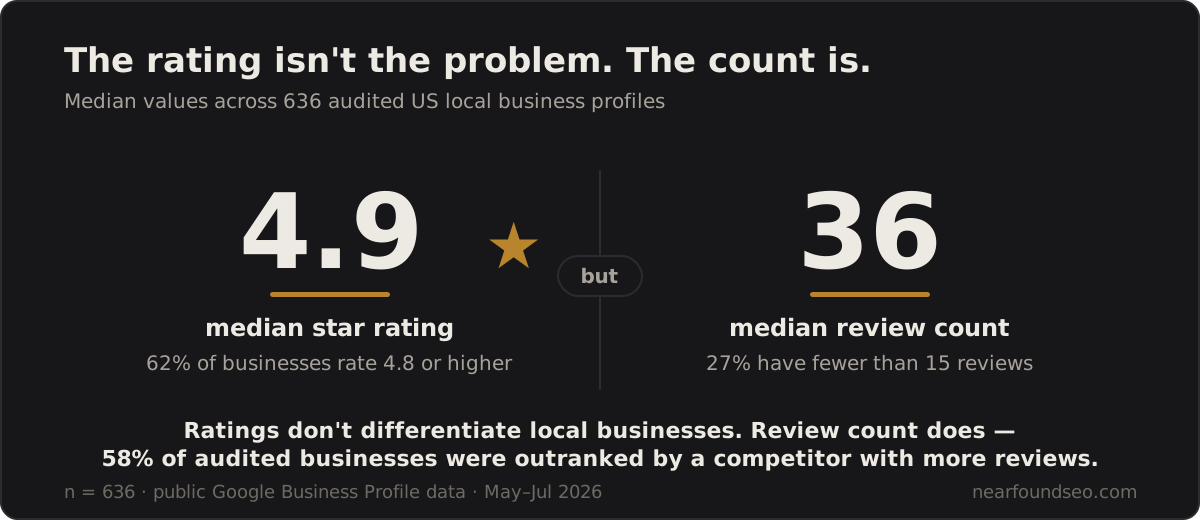
The single most surprising number in the data: the median rating across all 636 businesses was 4.9 stars. Almost everyone’s rating is excellent. If you think your 4.8 is why you’re losing the map pack, it almost certainly isn’t.
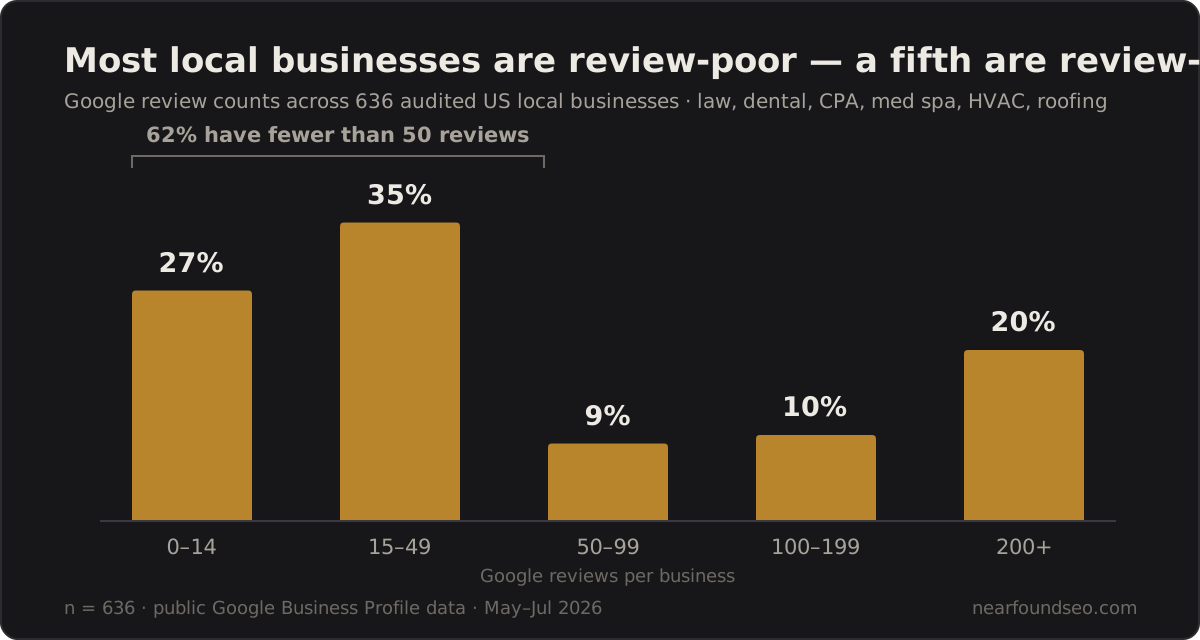
But the median review count was just 36 — and 27% of businesses had fewer than 15 reviews. Meanwhile, in 58% of the audits, the business was being outranked by a direct competitor with more reviews. Not better reviews. More.
That’s the real shape of the problem: local businesses treat reviews as a reputation issue (“keep the rating high”) when Google and customers both treat them as a volume-and-recency issue. A 4.9 with 20 reviews loses to a 4.7 with 140, essentially every time, in both the ranking and the click. If you do exactly one thing from this post, build a consistent ask — every happy customer, at the moment the work ends — and let the count compound.
2. Running on one category out of ten
Google lets every profile set one primary category plus up to nine secondary ones. Of the profiles where I checked category setup, a third were running on a single category — one out of ten slots used.
This is free ranking surface. A dental practice with only “Dentist” set is invisible for implant, orthodontic and cosmetic searches its competitors capture with secondary categories. An HVAC company with “HVAC contractor” alone forfeits “furnace repair service” and “air conditioning repair.” The fix takes ten minutes, and the way to do it isn’t guessing: look up what categories the three businesses above you in the pack are using, and match what’s true for you.
3. Basic hygiene: hours, holiday hours, and the fields nobody revisits
A smaller but painful group had operational basics wrong — hours missing or set so the profile showed “closed” during their actual peak search window. For an emergency trade like HVAC or a defense attorney whose clients search at 2 a.m., wrong hours don’t just cost the click; they end it. Same family of neglect: no services menu filled in, empty Q&A, a description written once in 2021.
Google reads an unmaintained profile the way customers do — as a business that might not pick up the phone.
4. The wrong primary category (rare, but fatal)
Only a handful of businesses in the data had this one, but it’s the most expensive mistake on the list, because the primary category is the strongest ranking signal on the profile. A med spa categorized as “Skin care clinic,” a family firm categorized as “General practice attorney” — each one competing in the wrong race entirely. If you’ve done everything else right and still don’t appear for your core search, check this first.
What I couldn’t measure from the outside — but see constantly
Three more from doing the hands-on work, offered as observation rather than data: stock photos (customers can tell, and Google’s systems increasingly can too), review responses that stop mid-2024 (a wall of unanswered reviews reads as absence), and profiles that have never used posts (activity is a freshness signal; silence is one too).
The same numbers, industry by industry
The sitewide medians hide real differences between industries. Here is the breakdown, from the same May–July 2026 audit:
| Industry | Audited | Outranked in the map pack by a rival with more reviews | What stood out |
|---|---|---|---|
| CPA & accounting firms | 201 | 55% | Median of just 9 reviews — the most review-starved industry we measured |
| Law firms | 105 | 67% | Tied for the most outrank-vulnerable industry |
| HVAC companies | 101 | 51% | — |
| Roofers | 95 | 54% | — |
| Dental practices | 89 | 67% | Median of 349 reviews — the review-richest industry we measured |
| Med spas | 42 | 60% | Median rating 5.0 — the rating was never the problem |
Two honest footnotes. First, the six rows sum to 633, not 636 — the remaining three audits were home-services companies, a seventh niche I no longer serve; they’re included in the sitewide numbers but didn’t earn their own row. Second, the smaller samples (med spas especially) deserve wider error bars than the headline numbers — treat the industry splits as strong signals, not decimals to bank on.
Cite these stats
Writers and researchers: every number here is from our own May–July 2026 audit of 636 US local business profiles — feel free to cite with a link to this page. Copy-paste versions:
- The median US local business has a 4.9-star Google rating but only 36 reviews (NearFound SEO audit of 636 local businesses, 2026).
- 27% of local businesses have fewer than 15 Google reviews; 62% have fewer than 50 (NearFound SEO, 2026).
- 58% of local businesses are outranked in the Google map pack by a competitor with more reviews (NearFound SEO, 2026).
- A third of local business profiles use only one Google Business Profile category out of the ten available (NearFound SEO, 2026).
- 1 in 5 local businesses has 200+ Google reviews — while the median is 36, showing how concentrated review wealth is (NearFound SEO, 2026).
Both charts on this page are embeddable — hotlink or download them, credit appreciated.
The pattern under all of it
None of these are sophisticated. That’s the actual finding: the map pack in most markets isn’t won by advanced tactics — it’s lost by neglect. The median business has a 4.9 rating, a half-built profile, and a competitor who simply asked more customers for reviews.
That’s fixable, and it’s exactly the first month of work in the GBP optimization program. If you want to know which of these is costing your business calls, the full audit is what I do on a free call — I’ll pull up your profile and your top three competitors live, and show you the gaps in fifteen minutes.